
Whitfield Tabernacle
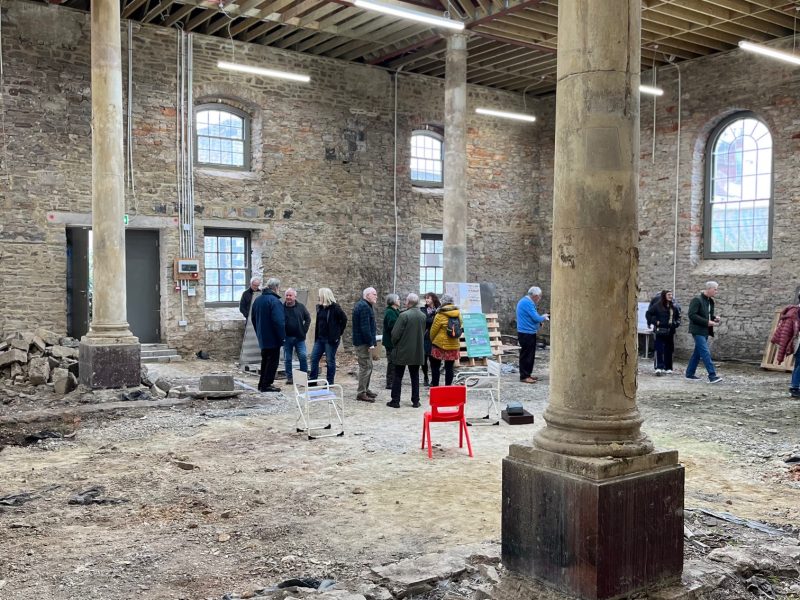
Trustees of the Kingswood’s Grade I Listed Whitfield Tabernacle were pleased to recently welcome members of the Kingswood History Society when they visited their partly restored building.
“We enjoyed being visited by a group of interested and well informed local residents’ said Trust Chair Anthony Hick.
“They asked good questions about our plans for the future use of the Tabernacle, and had some good ideas about how we might promote the project.”
Trustees were pleased that the local history group included some members who had belonged to the former Whitfield Building Preservation Trust that had been very supportive of the current Trust when it was formed in 2017.
“We’re all trying to play our part in reminding Kingswood about its interesting and significant past, but our priority now is to finish the development of the building so that it can benefit the community where it has stood since 1741,” said Rev] Hick.
The visitors were told that the Trust hoped they would return in 2026 when the Tabernacle would have a floor and the facilities to host a more comfortable visit.
Kim Scudamore
Kingswood History Society
Attendees commented how interesting they found the talk at our April meeting by Philip Ashworth on Piracy, Plunder and War in the Bristol Channel
Several new facts and unknown stories. Initially a distinction was made between Pirates and Privateers as the characters often switched between the two.
It was said that the anchorage off Portishead (The Kings Road) was more important than the Bristol Docks. Apart from the docks Minehead, Bridgwater were well-known and indeed there were plans for Martello Towers along the channel, although none built.
Lundy Island was quite prominent as being a navigational crossroads in the channel. You could hide your ship to one side of the island with a lookout on land and hence intercept. The months around St James fair in Bristol were particularly lucrative.
There was an interesting period in the 17th century when, after training provided by English sailors in the Mediterranean, Algerine pirates returned to the channel to capture many surprised home dwellers into slavery. Conversion to Islam lead to the phrase “Turning Turk”.
In the war with America in 1812, an American privateer targeted ships in the Channel which lead to a reprisal of the burning of the White House in Washington.
To finish, do you know why they are called pirates? Because they RRRR!
• Next meeting at the Park Centre, Kingswood is Tuesday May 6, 7pm for 7.30pm start. Visitors £4 incl tea/coffee and biscuits.
Presentation by Jeff Lucas; From Brycgstow to Bristol in 45 bridge
• Full schedule of presentations is at www.kingswoodhistorysociety.org
HANHAM WI
One might have expected this month’s talk to be a rather sober affair but the evening turned out to be anything but dull. Thanks to our engaging guest speaker, Alan Clarke, who kindly stepped in at short notice, members were treated to an enlightening and often amusing journey through one of the lesser-known historical chapters: the Temperance Movement.
Alan offered a compelling glimpse into the rise of temperance societies in Bristol—a movement that, while often overlooked today, once played a major role in shaping social attitudes towards alcohol.
Concerns about excessive drinking date back centuries. As early as the mid-1700s, the growing prevalence of alcohol consumption alarmed many social reformers. The artist William Hogarth famously captured this tension in his 1751 satirical prints Beer Street and Gin Lane, stark visual commentaries on the contrasting effects of beer and gin on society.
By 1830, the Temperance Movement was well established urging members to pledge total abstinence from alcohol. Despite resistance from both the public and the powerful brewing industry, these societies grew in popularity. Ironically, some of their early meetings are said to have taken place in rooms above pubs—a curious contrast to their core message.
As the movement gained momentum, purpose-built venues began to appear. Bristol’s first Temperance Hall, still standing on Broad Street, served as a hub for gatherings. To reach younger audiences, the Bristol Band of Hope Union was formed, emphasizing temperance education for children.
Efforts to provide alternatives to traditional drinking establishments led to the rise of temperance hotels and alcohol-free pubs, particularly around Temple Meads and Victoria Street. These venues, often found in the city’s less affluent neighbourhoods, served non-alcoholic beverages, and helped pave the way for cocoa and coffee houses. Public infrastructure also bore the stamp of the movement—the fountain at the junction of the Hanham and Kingswood roads in St George stands as a testament to this era.
In Kingswood, the movement arrived a little later, gaining momentum in 1865 with its base at the Zion Chapel. Public demonstrations and parades began in 1883 and continued all the way through to the 1980s, underscoring the movement’s lasting local impact.
Government action also followed, with Parliament introducing a series of regulatory acts. The most notable, the Beer Act of 1830, required public houses to obtain a licence costing three guineas—an early attempt to bring the industry under tighter control.
Although the movement saw a decline with the onset of World War I, its influence had already left a lasting mark on society. It challenged norms, reshaped public spaces, and fuelled debates about health, morality, and community responsibility.
Alan concluded his talk with a surprising statistic from a snapshot survey taken on Saturday, January 8, 1882: nearly half the population of Bristol had visited a pub that day. A striking reminder of just how pervasive alcohol culture once was—and just how ambitious the temperance campaign had to be.
What might have seemed a dry subject turned out to be a spirited evening of history, humour, and insight. Many thanks to Alan Clarke for bringing this fascinating slice of Bristol’s past so vividly to life.
Dianna Coles
LONGWELL GREEN WI
Most women can relate to the phrase “women love handbags” so members were excited to hear Sarah Delves give a presentation on “Bags of Glamour”.
Sarah’s father collected Georgian silver and, as a young girl, she accompanied him to antiques fairs. Her passion as an antique dealer in handbags started from here.
She told us that the earliest bag found was from Otzi, also called the Iceman. He is a glacier mummy dating back to around 3300 BC, found by hikers in Italy. When he was defrosted, an animal-skin leather bag was found at his waist. It had two slits serving as pockets to hold implements such as a hunting knife.
The remains of what was believed to be a Stone Age purse found in Germany, was adorned with 100 white pieces pointing in one direction. Members were asked to guess what these white pieces were. One member replied “children’s teeth”. It was, in fact, dog’s teeth.
The richest bag found to-date, is the remains of a purse lid from a leather pouch from the 7th century with gold, garnet and millefiori, from the Sutton Hoo treasure, which is on display in the British Museum.
Through the ages, the size of your bag indicated your class in society. The bigger the bag the lower down in society you were, as it indicated that the bag was used for work to carry your tools. The wealthy citizens carried tiny bags with gold, silver threads and beads – not even big enough to carry an iPhone!
Today, the designer Simon Port Challis designs 2-inch handbags, large enough to hold a credit card, which one could say is all you need to enjoy a good night out.
The world’s most expensive handbag, the Hermès Sac Bijou Birkin, is worth $2 million (a little over £1.5M) and was designed by Pierre Hardy. The miniature handbag, intended to be worn as a bracelet, features over 2,000 diamonds set in rose gold and it is reported there are only three such bags in existence. As an investment piece this would definitely take up a lot less space than a painting!
Now that Spring is here, the ‘Happy Feet’ walkers enjoyed the sunshine on a glorious day walking from the Swineford picnic site to Saltford via the new pedestrian bridgeover the river built by Wessex Water. The route followed the river by the Jolly Sailor, along the Shallows to the Bird in Hand, where members enjoyed a well-earned coffee. The return journey took walkers along the Bristol to Bath cycle path, onto the bridge at Kelston, descending to the river and crossing the fields back to Swineford.
A memorable event was held at the end of April in the Longwell Green Community Centre. This was the WI’s 71st Birthday Party celebration, where members enjoyed a sit-down buffet meal followed by entertainment and dancing.
It is great to see three new members join bringing the membership to 83.
We have lots of groups that our members can participate in. There are book clubs, walking groups, knitting group, skittles and social suppers. On the first Thursday of the month, we meet at The Chapel Coffee Shop in Longwell Green for Tea and Chat.
The Longwell Green WI’s monthly meetings are held on the third Friday of the month at 7.30 pm at the Longwell Green Community Centre and new members are always welcome. If you are interested in visiting, please get in touch by email at longwellwi@gmail.com, telephone 0117 9864782 or come along on the meeting evening. We shall look forward to meeting you.
Kamann Huang
BITTON WI
Our group met again on Monday 14 April when we were looking forward to hearing from our speaker this month who would be talking to us on a well timed theme of Gloucestershire Gardens, great and small.
Our summer outing which usually takes place instead of our August meeting is to be a river cruise with a cream tea. We will be giving out full details of the trip and taking names at our May meeting.
Our crafting team are soon to get together to look at making the post box topper for the competition being held this summer. We are looking forward to seeing how that goes and keeping our fingers crossed for a win!
We all enjoyed an informative talk by Marion Hill, a Green Pledge Learning and Outreach Officer, working on a two year Heritage Lottery funded project.
We discussed why we loved our gardens and why many of us liked to “garden”, with the general view being that it benefited our own health and wellbeing to be able to accomplish a beautiful garden or allotment, or just to sit and admire it!
Marion noted that gardening became popular for ‘ordinary’ people after the world wars when homeowners were urged to grow food for themselves and support the war effort. She said gardening of sorts started thousands of years ago when monks grew herbs to use as medicines. The Tudors liked to show off their gardens as a sign of great wealth with plants brought back on merchant ships. Houses such as Dyrham House and Dodington House were among those who had many gardeners to plan, design and cultivate the types of wonderful gardens we associate with big houses today.
Next meeting will be held on Monday 12 May 2025, Church Hall, Church Lane, Bitton at 2 pm when our speaker will be advising us on the complexities of Inheritance Tax.
Karen Davidson, president
SOUTH GLOS WINE CIRCLE
Our April meeting was entitled ‘Four Countries One Grape’ and featured the grape Voignier from France, Australia, Argentina, Chile. The tasting was done ‘blind’ [ie the bottles wrapped to conceal identity]. Members then asked to choose their favourite, then identify the country and finally the grape. Much conversation ensued with lots of different opinions, the French wine being mostly identified. We welcomed two visitors who also had a great time with the tasting.
Our May meeting on the 7th will be our promoted open night when we will be welcoming like minded people who are interested in learning about wine, beer and food combinations. We hope to see you then but please let us know if you would like to come and we will make sure you have a warm welcome. Email carol@applause.co.uk
Carol Coombs , Programme Secretary